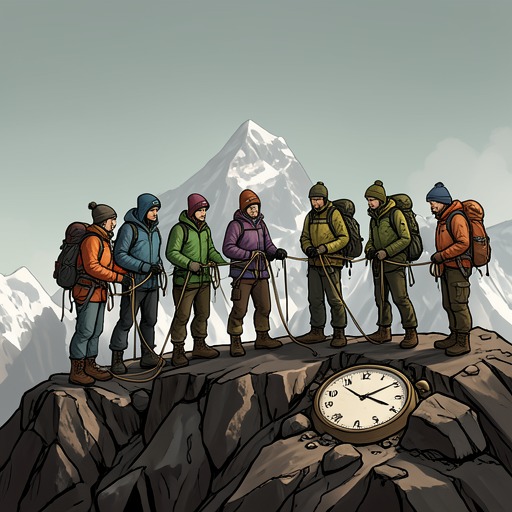
Hall team’s summit turnaround deadline
The ClimbHall team’s summit turnaround deadline was a safety limit whose uncertain communication became consequential during the delayed May 10, 1996 climb. Some clients understood that Rob Hall’s team would turn around at one o’clock, others at two, and still others believed the decision would be made on the mountain; when the stated two-o’clock limit was finally confirmed by radio, it had already passed. The account makes the deadline more than a clock reading: it was a shared rule only in name, while climbers faced the decision separately amid exhaustion, a crowded route, and dwindling oxygen.
The deadline and its ambiguity
Hall had not fixed a single, clearly understood turnaround time for his clients. Lou Kasischke recalled a one-o’clock limit, and Stuart Hutchison believed that the late hour and the logjam made it impossible to descend by then. Other members of the team thought the deadline was two o’clock, while some understood that either time might apply and that Hall would make the decision during the ascent. The variation was not a minor difference in recollection: it left climbers without a common point at which continuing became a breach of the plan.
The contrast with Scott Fischer’s guidance sharpens the problem. A profile published before summit day described Fischer’s personal Two O’Clock Rule: a climber not on top by two should turn back, because darkness is dangerous. Fischer did not, however, set a definite turnaround time for his own clients that day either. His plan relied on Fischer catching stragglers and turning them around, with Lopsang Jangbu Sherpa near the front and radio contact between them if problems arose. Hall’s clients, by contrast, held different understandings of their cutoff, and the narrative records no equivalent, unambiguous deadline reaching each of them.
The logjam and a client’s decision
At 10:30 in the morning, Hall’s clients were spread from the Balcony to below the South Summit among Fischer’s clients and the Taiwanese climbers. At the recommended oxygen flow rate, climbers who had started on their second canister had only one to two hours of oxygen left; the third and last canisters had yet to reach the South Summit. The Sherpas carrying them were also dispersed along the route. The delay therefore compounded a practical danger: the deadline was uncertain just as time, oxygen, and room to move were all becoming scarce.
Near the back of the queue, Kasischke passed John Taske and spoke with Hutchison, who was coming down. Hutchison expected Rob Hall to turn everyone around because the congestion made returning by one o’clock seem unattainable. Kasischke, still intent on the summit, moved on. The exchange planted a warning, but did not itself settle the question of what the team’s rule was or whether Hall would enforce it.
Around 11:30, below the South Summit, Kasischke clipped into the rope and knelt to rest in the queue. His water was frozen in his pack, so he scooped snow with a bare hand. He knew his fingers were frostbitten, but had continued because summiting mattered so much to him. The pause forced a reassessment: the spectacular views he had seen earlier from the Balcony had disappeared behind poor visibility. When a Sherpa told him the summit was still two hours away, Kasischke realized the danger was not simply whether he could reach the top, but whether he could get down alive and without losing fingers or toes.
Kasischke described an inner contest between the urge to continue and the fear that the descent would kill or permanently injure him. He asked the Sherpa to tell Hall that he had decided to turn back. The decision took only four or five minutes, and Kasischke later said Hutchison’s warning may have influenced him, but that he ultimately acted on his own assessment of his condition and ability to descend. His account shows what the absent shared cutoff meant in practice: a client had to make a life-and-death judgment without relying on a consistently understood team deadline.
The missed cutoff
The clearest confirmation of Hall’s stated time came from Henry Todd, watching the climbers from Camp II with others. Seeing the late hour, the Sherpas repeatedly expressed alarm. Todd called Hall’s Base Camp by radio and asked for the turnaround time. The response was two o’clock. By then, two o’clock had come and gone. Todd’s account turns the deadline into a concrete failure of timing and communication: the official answer arrived after the limit it named.
The same delay had already exposed the cost of leaving the cutoff unsettled. On the upper mountain, climbers were still spread along the route, and the oxygen carried for them had not all arrived at the South Summit. A late summit push left less time for the descent, while the worsening visibility reduced the value of simply pressing onward. Todd also described exhausted climbers as losing the capacity to reason clearly and believing they could endure more than they could safely manage. The deadline was intended to constrain precisely that impulse, but a rule that clients understood differently could not function as a reliable collective safeguard.
Testimony and the record
The book’s account of the deadline is assembled through recollections rather than presented as a single uncontested transcript of what every client was told. Five days after the disaster, nine climbers sat in a circle at Mountain Madness Everest Base Camp and recorded their thoughts and memories. The authors drew many details and quotations from that debriefing, describing the participants’ efforts at truth-telling and self-reflection as a contribution to the historical record. The different understandings of Hall’s cutoff thus remain visible rather than being smoothed into one tidy version.
That attention to testimony matters because recollection at altitude and recollection afterward are not identical to an agreed plan. A later dispute over what was said near the Hillary Step illustrates the problem: Martin Adams clarified that Jon Krakauer had not heard a conversation between Adams and Fischer, or a comment by Anatoli Boukreev to Fischer about descending with Adams. The episode does not establish what Hall told his clients about the deadline, but it demonstrates why the account distinguishes what a participant recalled from what another person could have witnessed.
The deadline’s significance lies in the gap between a safety rule and its operation. Hall’s clients did not carry one common understanding of when they should stop; the radio confirmation of two o’clock came too late to guide the climbers still above, while individuals such as Kasischke had to weigh the risks from their own physical condition and the mounting delay. The book preserves both the intended boundary and the uncertainty surrounding it, making clear that a time limit can only protect a team when it is communicated clearly and acted on before the moment it is meant to govern.